Author: andrea Page 65 of 71

Unrepentant Anglophile, a music obsessive with a fetish for luxuriously packaged objects, and an armchair traveler.

The Raincoats :: Adventures Close to Home

gina+ana 1979

This is another archival interview from Warped Reality’s first incarnation as a print zine. I’ve reprinted it as-is, so keep in mind that any references to the present are speaking of 1994!

***
The songs of the Raincoats seem to stem from some collective unconscious: upon first hearing them, one is struck both by their familiarity and their newness —it’s a language you’ve longed to hear although you’ve never heard anything like it before.

There surprise with their complexity, their elasticity, their playfulness that comes (perhaps) from their having built a musical language all their own. The Raincoats threw themselves fearlessly into the musical arena… and were often as surprised and exhilarated as the audience by the sounds that they produced.

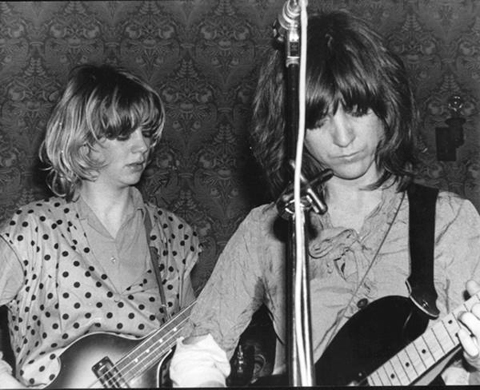
The Raincoats formed in London in 1976. Ana DaSilva had recently arrived from her native Portugal. Gina Birch was from Nottingham. Both were attending art school. The atmosphere in London was already altering. Says Gina of that time, “People kept comparing the punk movement to Dada and stuff —which was probably a bit high flown! But, at the same time, there were a lot of interesting ideas going around. The first fanzines started, like Sniffing Glue. People were doing crazy things, interesting things, interesting fashion. “ Adds Ana, “It was really exciting, like you were in the middle of history happening.”

Ana and Gina soon became part of the insular London music scene, generally spending their time at the infamous and short-lived Roxy. “We started going to these gigs at the Roxy, and everyone there was going on about how easy it was and how everyone should do it if they felt like it. Gina and I went for a drink in a pub and just thought, ‘Oh, let’s do it!’” Gina laughs. “I remember when I bought my bass. We were in some political conference at Acme Gallery, which was near Shaftesbury Avenue where they sell guitars. On the lunch break, I went down to Shaftesbury Avenue and bought a bass for £40! And then I had my instrument. I took it home and spray-painted it bright blue!”

More cheeky than punk, really, but the spirit was there. The Raincoats aren’t usually mentioned in the “punk” category; often, they’re not mentioned at all. “We were considered very unhip by some people!” laughs Gina. “I think we were a bit bleak,” adds Ana. Their songs were too subtle for punk —there were no obvious sloganeering anthems or big, aggressive gestures. They weren’t afraid of harnessing the power of quiet moments. They were expert at giving a song added power by shaping it, giving it jolts and starts; alternating the soft with the angular. It is the careful orchestration and accretion of these subtle moments that makes Raincoats songs so alluring.

Now that the Raincoats are being rediscovered, thanks to the reissues of their first three albums, they have resumed recording and touring again. The core of the band remains Gina and Ana (Vicky is running a dance music label, Palmolive is living on the Cape and drums in a Christian rock band that covers Slits songs, albeit radically altered); they have been joined by Anne Wood on violin and bass and Heather Dunn (ex-Tiger Trap) on drums. (Steve Shelley filled in for a little while too.) Although an extensive tour of the US was cut short by the untimely death of Kurt Cobain, the Raincoats nevertheless played a short tour of the East Coast, culminating in a sold-out two-night stint opening for critics’ darling, Liz Phair. (Make that former critics’ darling. —Ed.)

Liz interrupted her set to say, “I don’t know how many of you know who the Raincoats are, but I hope you know what a special thing you just witnessed.” To judge by the exponential amount of applause the Raincoats’ set garnered, they realized all too well. “We’re not leaving yet!” laughed Ana from the glare of the stage after a particularly raucous burst of applause and cheers.

Gina and Ana played a virtual retrospective of the band’s history, from the wry, startling “Fairytale in the Supermarket” and “No Side to Fall In” from their first album, The Raincoats, to later songs like “No-One’s Little Girl,” “Shouting Out Loud,” and “Balloonacy.” They also played two new songs, “Don’t Be Mean” and “Smile” that have since shown up on their Peel Sessions EP. For encores, they played their gender-bending take on the Kinks’ “Lola” and the equally amusing “Love Lies Limp” (an Alternative TV song). They also joined Liz onstage to sing the wonderfully brash chorus of “Flower.”

Most wonderful of all was their version of “You’re A Million,” one of my favorite songs from The Raincoats. Tense violin spirals upwards, momentarily graceful and elegiac, then suddenly taut, sharp. “This is for you, as my love that was for nobody,” sings Ana, whose voice go quiet and regretful. Then, a pause, full of tension, as the violin begins its slow spiral upwards. “Stop here and go away!” she shrieks, as the percussion enters —too fast, unwieldy, awkward. Ana cuts it off with a sharp, “Stop here!” and it does. The inertia of the song is halted, in a moment that truly shatters. When Ana sings again, Gina’s voice joins her in harmony: “We’re a million to go,” as the violin goes quiet again.

Watching them, I think I’d be content if I never saw another concert again. It was rare and joyous in a way that few concerts are. After their set, Ana came down off the stage and was standing next to me. Still speechless from their set, I eked out a quiet, “That was incredible. Absolutely amazing.” “Thank you,” she said, quietly.

The Raincoats’ time has come again. They were ahead of their time in 1976, and now the musical generation that was influenced by them —a select but important number— have created an atmosphere perfect for their return. In 1977, they were pioneers. Now, they are pioneers.

***

MP3the Raincoats, “You’re A Million” Taken from their amazing debut album, the US version of which is OUP but it’s still available from Rough Trade.

Although the Raincoats haven’t put out another album since 1996‘s Looking In the Shadows, they’ve never really broken up. The duo still perform together and I suspect they’re working on new material as I type. Check their new web-site for news. While there’s not much there at the moment, they promise plenty of lovely goodies soon. (I’m hoping for some of Gina’s lovely videos myself, including clips for “Don’t Be Mean” and “Fairytale in the Supermarket.”)

MP3Red Krayola with Art & Language, “Old Man’s Dream.”

Gina also performed with Mayo Thompson’s Red Krayola (with Art & Language) —a lineup that featured Epic Soundtracks, Lora Logic, and Allen Ravenstine (Pere Ubu). This song, “Old Man’s Dream,” is taken from their album Kangaroo?

My interview with Mayo Thompson is here. Kangaroo? is available from Drag City.

Spring Forward

Lotus

It’s been freezing, freezing cold here. And as I was walking home from work the other evening a song came on the old shuffle —a song so soufflé-light, with birds chirping and Spanish guitar and a voice as airy as early morning sunlight filtering through the trees— that I momentarily forgot about the ice cold, brutal wind whipping right through me and stinging my eyes.

Spring songs are different than summer songs. Summer songs are carnal, sun-drenched and earthy. They’re a little bit crude, certainly more anthemic. By contrast, spring songs are just waking up to sensuality. They’re quiet, yes, but also quietly celebratory. They, like the fog, come in stealthily, on little cat feet—taking you by surprise, just like the first tiny blossoms of a season that’s far too short to wear out its welcome (as summer often does). The world they paint is new and a little bit magical.

Dean and Britta’s “Knives from Bavaria” is like that. It’s a very strange song. The lyrics are nonsensical, for the most part, but a bit obsessive in the middle there. (Thanks to the repeated refrain: “I love him, I love him, I love him I do.”) Here the production makes all the difference: when I listen to it on headphones it’s almost too rich, a crème brulée with a dollop of cassis at the centre. But I never tire of it —its lushness and heady quality are irresistible, whether it’s the first time I’m listening or the 1000th. Part of this is due to the lovely, sensuous interplay between the two voices (Luna’s Dean Wareham and Britta Phillips —yes, the voice of Jem) —the emotional timbre they hit here is one of cautious ebullience. There’s this tinge of melancholy that inhibits the song from becoming a blithe summer tune. But it’s lightened by marimba (a jaunty, spring-like instrument if there ever was one) and the requisite yé yé “la la la”s. “Send me a rainbow, send me a word,” Britta sings, and I wonder if playing the song over and over will bring a winter thaw that much sooner.

Does such a song really exist, I wonder?

Hmm.

Guess I’ll turn the heat up.

***
MP3Britta Phillips & Dean Wareham, “Knives from Bavaria”

You can watch the video for “Knives” at Dean & Britta’s website. Their album, “L’Avventura” (named after the atmospheric Antonioni film) is available at Amazon and elsewhere; they’re recording a follow-up now. A tour will follow in the spring.

His Name Is Alive Week :: Part Four :: DETROLA

HNIA-FourI once compared Warn Defever to Max Ernst. This was way back, King of Sweet-era, even, and I thought of him as this mad genius who played with repetition and texture in the most fascinating ways,
creating a body of work that felt marvelously out of time. Even if it had discernable stylistic earmarks here and there, they were difficult to pinpoint amidst the dense sonic collages.

Fast-forward to 2006’s Detrola. We’re not in sepia-toned Ernst-land anymore, nor have we been for quite some time. But the fascination with repetition and texture is still there, even if, over time, the influences have become more obvious. Defever is working in a purely American idiom: writing deceptively throwaway pop songs with an unvarnished center of elegiac heartbreak. He gets purely bright, bubbly American voices to sing them. (Detrola features three singers: Erika Hoffmann, Lovetta Pippen, and newcomer Andy FM.) There are occasional echoes of the early His Name Is Alive sound—Detrola opens with the mournful, bleak “The Darkess Night,” which is anchored by cello, downbeat saxophone, drones and bells (an unexpected but lovely accent). From there, though, it’s anything goes as Defever casts his seemingly omnivorous range of influences far and wide across the album’s eleven tracks. The dominant strain of influence appears to be 70s MOR —think Carole King, the Carpenters, Memphis soul. It’s a tribute to Warn’s talent that the music never comes off as mere pastiche or as slavishly imitative —everything he touches he makes his own. And he does so in a quietly audacious, ego-free way.

HNIA albums sometimes remind me of that famous quote about the weather in San Francisco: “If you don’t like it, wait a second and it’ll change.” Detrola is no different, making stylistic leaps from song to song —from the unerringly Carpenterish “Get Your Curse On” to the soulful, funkified “I Thought I Saw” and closing with the mournful “Send My Face To Your Funeral.” But it’s Warn’s stylistic fearlessness and wry sense of humor that makes his albums such a consistent delight, even if you sometimes wish he were a bit more disciplined. But then, he wouldn’t be Warn and we’d miss his aesthetic omnivorousness. After all, who else is going to aim for sounding like “Dead Moon-meets-Pharaoh Sanders” (and succeed)?! I ask you.

Warn very kindly submitted to my line of questioning. Here’s what he had to say…

It seems as though with every HNIA album there’s a new HNIA —not just in sound, but in personnel, instrumentation, aesthetic presentation, everything. This seems like one of the most full- bodied, well-integrated HNIAs we’ve seen in awhile. How did HNIA mach 2005/6 come together? How did you find (relatively) new singer Andrea? Or do people find you?

These are tough questions with days and days worth of answers, so I’ll try to answer them in an abbreviated style: I spent the last couple years primarily recording other bands in the studio I opened in detroit, called BROWNRICE. One of the bands I recorded was Detroits’ most super punk ass band called the Piranhas. The Piranhas are the kind of band where the singer takes off his pants and pees into a trombone and then plays the trombone and tries to shoot pee all over you (in the studio). Last year I had a party and they all came over my house and when all the alcohol was gone, we started drinking the brown smelly water at the bottom of the flower vases (we didn’t die). Then Ian (the Piranhas’ guitar player) and his girlfriend (Andy FM) started singing me Elvis songs as a birthday present. It was great!!! I asked them if they wanted to record a tribute to Elvis and Andy said she hated Elvis. So I wrote some new songs just for her to record, next thing you know….. >>cont’d

Every HNIA album feels to some extent like a mix tape made for a (possibly errant, erratic, or otherwise elusive) lover. If Someday My Blues… was the breakup album, Detrola is the _______? And, if it’s hard to simplify like that, what was your intent?

It’s not really like a mix tape, it’s like a mixed up tape.

Detrola seems like your take on the classic American MOR songbook (Carole King, the Carpenters, etc.). Was this a new challenge you set for yourself, or a natural evolution? Is there such a thing as a platonically perfect American musical vernacular? You seem to be so comfortable in all these different idioms, trying them on for size, subverting them, chopping them up Tzara-style into something that’s got your particular stamp on it. It seems, in a way, like you’ve been making mash-ups from the very beginning of HNIA’s existence. How would you characterize HNIA’s evolution?

I guess I don’t really think about it that much. In the past I think I tried really hard not to repeat myself. Like everything has to be constantly moving. For Detrola I tried to stick to what I already knew, like my comfort zone. Although I guess when I actually try to remember what was going on I think its really the same every time.

I start a new song and it’s like a totally blank piece of paper and I have no idea what I’m doing and that I have learned nothing over the years and I can’t even remember what music is supposed to sound like.

HNIA-PullQuote

How has Detroit shaped your sound? Can you imagine HNIA existing anywhere else? Speaking of Detroit influences, did you really record the Stooges recently, or is that a bit like how Simon LeBon “produced” Unrest’s Perfect Teeth?

Question disqualified on grounds that it is really two or three questions in one.

Do you listen to your own music with a critical ear, or is it possible to lose yourself in it?

The time that I enjoy my own music the most is while I’m working on it, in the studio. I usually don’t go back and listen to it, but if I do the worst part is always my own performance especially if I try to sing.

Have you ever surprised yourself with something you’ve written? Maybe you played it back later and thought, “I wrote that?!” Was it a happy accident you later tried to incorporate into your palette, or did it find its way into your working methods in some other way?

It’s usually the opposite, I hear something that someone else did and I think “I wrote that” but it always turns out to have been written or recorded ten to twenty years before I was even born, and then I try to figure out how George Gershwin was able to build a time machine go into the future and steal all my ideas and then go back to the 1920’s and write “Rhapsody in Blue.” This happens a lot.

Pop-culture item(s) that mean(s) a lot to you (that’s not music)? (book, poem, film, beautiful hand-painted sign, etc.) Do you first have the first beat-up cassette/45/8-track/stone carving you ever owned? What was it? (Mine was Nena, “99 Luftballons.” C-30, C-60, C-90, go!)

ELO “Out of the Blue” was the first or second album I bought myself but I do have a hazy recollection of going in halfs with my older brother on a ZZ Top album too… I think it’s all pop culture: cell phones, elvis, internet, text messages, hotspace, eating, books, buddhism, cambodia, whatever. It’s how you take it in. If you’re all super-serious about something then it ceases to be pop culture —like all the critical analysis we’re seeing lately about 80’s hardcore scene. But since I take nothing seriously it’s all pop culture to me.

When you’re young you (usually) digest music in a fairly non-discerning fashion (ie, passively). What song or band marked a turning point for you, when you realized there was a real power & expressiveness in music?

I started playing music at an early age with my family and the first real music I discovered on my own was Elvis and then rockabilly and surf music. I had grown up surrounded by music —country, western, polkas, waltzes, but that wasn’t really my own thing. When I first heard Elvis I couldn’t believe the energy and raw power. It’s hard to explain why I was in some sort of time warp or whatever…

The late Egg Magazine’s music reviews consisted solely of the dollar amount they thought the album was worth. How would your most recent music purchases shake down for cash based on aesthetic & artistic, not retail worth? (Bonus: How’d you rate HNIA’s oeuvre?)

I think it should be free if you’re under thirty years old. If you’re older you should have to pay.

***

MP3The Pine Cone II from the Cloud Box Sampler[right-click-save-as, s’il vous plaît]

MP3Reincarnation (Early Music version)”

MP3Get Your Curse (Summerbird version)

For His Name Is Alive news, tour dates, and free downloads, visit their official website. For more goodies take a look at Silver Mountain. Detrola is available at fine retailers everywhere.

Page 65 of 71

Powered by WordPress & Theme by Anders Norén