Author: andrea Page 70 of 71

Unrepentant Anglophile, a music obsessive with a fetish for luxuriously packaged objects, and an armchair traveler.

The What Else Is New List, 2005

I’m not going to do a Top Ten, because I’m not even sure I have a Top Ten for the year. It was that kind of year. (And, to be honest, I haven’t even bought the Ladytron or Broadcast albums yet—both of which need to be evaluated for a true Top 10 List).

I listened to a lot of Wolfgang Press this year, rediscovered Arto Lindsay and DNA in a big way, enjoyed the new Electrelane, Franz Ferdinand, and Knitters albums quite a lot. New Stereolab six-song EP was passable but more of the same, and hence, a pleasant enough disappointment. (I think I’ve maxed out on the ‘lab, sadly. Although I did find myself listening to Switched On and Peng! quite a bit so maybe it’s just new ‘lab that’s irking me with its drab meanderings. Hmm.)

Anyway, the list. Short but hopefully sweet: [cont’d>>]

frame

1) THE OCCASION, Cannery Hours (say hey!)
Live, Sin-é [August 2005], Middle East Café [October 2005]

I’m not even sure at this point when or how I stumbled across the Occasion. But I do remember the precise moment that I heard “I Can’t Stop Falling.” It’s a song so compelling you just fall effortlessly into the little world it creates, this pocket fiction you want to take with you and study with rapt, slightly stunned attention. The refrain “I can’t stop falling,” repeated often and with a slowly escalating sense of desperation, is punctuated by sharp, startling whip-cracks of percussion. It is by turns quiet and poetic, furious and tense. “Sooner or later it will come to me,” singer Jordi Wheeler whispers, sounding like a man resigned to a peculiar sort-of hell that he both fears and welcomes.

After some investigating, I found out that “Falling” was off of their self-titled debut [Say Hey, 2004]. Their new album, Cannery Hours [Say Hey], is equally intense, building on similar timeless, enigmatic lyrical concerns and playful sense of sonic experimentation. Musically, the band paints in watercolors —sometimes in broad, dusky swathes, sometimes with bright, pointillist delicacy. Equal parts fitful and elusive, songs like the epic “The Maiden” and the stoic “Register My Complaints” evoke parched soundscapes —deserts where one or two hardy species of plant survive, seemingly against all odds. “You May Know Me” is touched with a rare, effortless sense of grace and buoyed by double-tracked, gentle harmonies and Brent Cordero’s plangent piano. In addition to the somewhat formal, elegiac quality, there’s also a subtle, surreal sense of whimsy at work. “What is this?” Jordi sings on “Register My Complaints”, “Is it the work of some imaginative florist?”

Loosely speaking, The Occasion traffic in a kind of pastoral psychedelia. Psychedelia is, at heart, about freeing music from earthbound limitations, and in turn invoking a trance-like state in the listener. And the sum total of the Occasion’s music offers no such balm. Songs often begin with undulating, gentle waves of sound, lulling you into a false sense of complacency, only to stun you with distortion and rumbling basslines. From there, it builds to these incredible crescendos, pulling you effortlessly to the top of a massive swell and leaving you there, slightly stunned and wondering how in the hell you’re going to get down to Earth again.

The band is, in some ways, a bit of a Frankenstein creature —the push and pull of influences is sometimes internal, and they’re a better band for it. While their sound certainly has some antecedents in the 60s and 70s (the Velvets, Cale, Tony Conrad, echoes of the motorik mantras of Can, Amon Duul II, and Neu!) it also has the crisp single-mindedness and emotional raggedness of post-punk, post-rock groups like Savage Republic, Slint, and Scenic. (The S’s in a row were purely coincidental.) They manage to incorporate three singers —Brent Cordero (vocals, Rhodes piano), Charles Burst (vocals, drums), and Jordi Wheeler (vocals, guitar)— without compromising individual songwriting styles. Yet, somehow, everything coalesces in this incredibly organic way, aided and abetted by the equally impressive contributions of bassist Marlon Sporer and tape loop guru/percussionist Sara Shaw, whose deft way with splicing gives the songs their tenacious, slightly windswept quality.

I’ve caught the band live twice now —once during CMJ at Sin-é, and recently at Boston’s Middle East, where they were opening for Acid Mothers Temple. Both shows were impressive in different ways, The first because the band took their limited time and ran with it, giving us a concise set that never once let up in intensity. Seeing them a little over a month later at the Middle East, it was clear that touring with loose-limbed collective Acid Mothers Temple had liberated the band in some crucial ways. Songs that were organic to begin with became even more freeform, ebbing and flowing with a newfound confidence and innate sense of trust. That, and they seemed to be having a lot more fun.

Long story short: live or on record, they’re a fantastic band and you would do well to have a listen to the MP3s posted on the Say Hey website. Or over at Beekiller.

frame

2) CITIZEN’S BAND [Deitch Projects]

This insane anarcho-cabaret collective/variety show spectacle includes Rain Phoenix, Karen Elson, Ian Buchanan (Twin Peaks) and (seemingly) an entire Coney Island Freak Show of insanely talented polymaths. I haven’t been lucky enough to catch one of their shows yet (they’re affiliated with Deitch Projects in NYC) but I can only imagine it’s like seeing Isadora Duncan, Mistiguett, Rasputina, and the Tiger Lillies playing Madame Nelson’s brothel on New Year’s Eve, a Gorey-esque, technicolor penny dreadful as bawdy, raucous, and wry as it is colorful. The group mixes originals with well-chosen covers, and plays music that is as mordantly funny (“Je T’Aime Scumbag”) as it is tender (Karen Elson’s heartbreaking reworking of the Velvets classic, “Candy Says”). I’m waiting (not-so-patiently) for them to release something officially, either an entire show on DVD or a cast recording/selection. I missed their latest opus The Trepanning Opera but hope to make it to whatever they’re offering up in the new year.
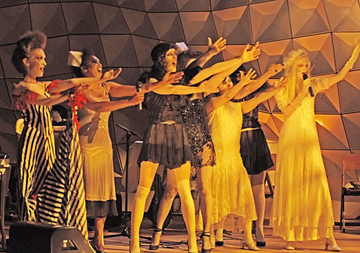
citizen'sband-trepanningKaren Elson’s version of “Candy Says” is one of the most affecting songs I’ve heard all year. Given Elson’s background as a model, the song becomes a poignant exploration of a woman’s alienation from her own body —giving a nice, O. Henry-ish twist to the original’s plaintive longing of a transvestite to embody the feminine and understand the secret, elusive language of girls. Elson’s emotionally concise, nakedly vulnerable reading and her simple accompaniment on autoharp gives the song a tenacious delicacy that Candy Darling herself would have no doubt appreciated.

The Citizen’s Band
MP3Karen Elson with Citizen’s Band, “Candy Says” [right-click-save, s’il vous plaît]

frame

3) SONS AND DAUGHTERS, The Repulsion Box [Domino]

The Repulsion Box didn’t quite live up to the short, spiky promise of debut EP “Love the Cup” but it came close. Live, this band tore into their songs with everything they had and it was special indeed.

From my live review of their October Boston show: “This spiky but tender gender-balanced quartet won’t pull their emotional punches when they can throw them (especially fitting when you remember that half of the group formerly worked with arch-miserablists Arab Strap). Led by co-conspirators Scott Paterson and Adele Bethel, the group draws heavily on folk and country influences: think Appalachian murder ballads and sinister, countrified rave-ups, a little Gothic and roughed-up —more Johnny Cash, X, and Gun Club than Grand Ol’ Opry. Their songs collectively inhabit some erstwhile Bermuda triangle between gray, smog-riddled Glasgow and a dusty roadhouse out on a lonely expanse of two-lane blacktop.

Onstage, the emotional intensity between Patterson and Bethel barely ever lets up. Paterson plays the stoic, silent card, while Bethel slinks across the stage, evoking such rock femme fatales as Poison Ivy Rorschach and Exene Cervenka but effortlessly holding her own.

The songs —narrative tragedies of love gone wrong, love gone sour, of love gone, period, full-stop— are tough as nails, but possessed of narrative breadth and delicacy that softens them just enough. Time after time they cut close to the bone with restless, harrowing precision. Take, for example, a song like “Gone”: with its use of handclaps, brisk syncopation, and “la la la” harmonies, it could almost be could be a long-lost demo by a stripped-down, slightly sinister Shangri Las. That is, until Adele’s girlish coo veers sharply into a harrowing banshee wail. “I cut you out of every photograph within an inch of your life!” she spits out with shockingly pure, unmitigated rancor.

Every Sons and Daughters song is full-on, all flash and heat. But they’ve spun something darkly compelling and singularly vital out of such impetuous, romantic fatalism. Live, they’re even better: vibrant and luscious and a bit harrowing. See them if you can.”

Sons and Daughters
Domino Recording Co.

frame

4) GLASS CANDY, “Life After Sundown” 12”; Sugar & Whitebread EP [troubleman unlimited]

Any band that covers the Screamers, “Iko Iko” and the Rolling Stones has some cojones (not to mention a sense of humor). Glass Candy’s best release of the year by far was the incredible 12” single, “Life After Sundown,” a gloriously hi-NRG romp that plays out like the best song ESG never wrote, all dubby low-end and giddy hand-claps. If this doesn’t get you dancing around your office, there may be no hope for ya.

By comparison, “Sugar & Whitebread” is a pale imitation, but an enjoyable one. Tom Tom Club meets Blondie in a head-on collision of synth squiggles and cooler-than-permafrost vocals.

The band has posted on their Myspace page that they’ll soon be offering all their demos, remixes, and alternate versions of songs (over 50 in all) available as hi-res MP3 downloads. I’ll post the URL when it’s up.

Troubleman Unlimited
Glass Candy

frame

5) HIS NAME IS ALIVE, Summerbird EP (online release)

There’s a new HNIA album on the horizon, called Detrola. This EP, released online this past summer, was a lovely preamble, a buoyant and lovely collection of four sun-drenched, lush songs.

His Name Is Alive

frame

6) SIOUXSIE AND THE BANSHEES, Downside Up

What can I say? My Goth roots are showing. I’ll always love the Banshees, and this box-set gave me a chance to own all the odds and ends I was missing over the years —including two of my favorite B-sides, “Tattoo” (memorably covered by Tricky for his nearly god project), “Are You Still Dying, Darling?” and “Something Wicked This Way Comes.” All this and the Thorn EP too. Beautiful packaging is always a nice bonus.


frame

Albums I Didn’t Buy in 2005 but Should Have:

Psapp, Tiger, My Friend [Leaf]
50 Foot Wave, Free Music [throwing music]
Lali Puna, I Thought I Was Over That [Morr]
Matt Elliott, Drinking Songs [Merge]
Ilitch, 10 Suicides [Fractal]
Broadcast, Tender Buttons [warp]
Ladytron, Witching Hour [Ryko]
Celebration, Celebration [4AD]
The Rogers Sisters, Three Fingers [troubleman unlimited]
Amadou & Mariam, Dimanche a Bamako [nonesuch]
Kokono No. 1, Congotronics [Crammed]
 

A partir de là prendre les mots…

ruth

Music for writing in cafés, waiting for someone who will never arrive. Smoking endless cigarettes and stubbing them out in a cracked ashtray. The coffee is always tepid and the minute hand on the clock never moves.

MP3Ruth, Mots
[right-click-save-as, s’il vous plaît]

Someday I need to write a real post about this album, which is one of the most amazing things I’ve ever stumbled across (and I literally did, finding a dust-covered copy in the corner of the office where I used to work!). Until then, enjoy this track.

[“Mots” written by Eduard Nono & Thierry Müller, 1983.]

Bring Me The Head of the Red Krayola

In honor of the news that the folks at Drag City are hard at work on a documentary about the Red Krayola’s Mayo Thompson, I’m reposting an interview Susan and I did with him for the print version ofWarped Reality. 1995 was a veritable Summer of Red Krayola, with a whole slew of reissues courtesy of Dexter’s Cigar (including Thompson’s effortlessly charming solo debut, Corky’s Debt to His Father), and culminating in the first RK tour in a small forever.

The leader of ever-shifting musical collective RK (née Crayola, until a certain corporation got wind of it) has led the band through numerous incarnations (and initial public indifference) since 1968. From such humble beginnings as part of the Texas psych underground, Thompson slowly but surely forged ahead on his own deeply idiosyncratic path, collaborating with a stunning array of like-minded individuals along the way (Pere Ubu’s David Thomas, Jim O’Rourke, Albert Oehlen, David Grubbs, Gina Birch, Lora Logic, Epic Soundtracks, John McEntire —the list could go on and on) and becoming stealthily legendary. Thompson’s wry, philosophically pithy songs have influenced a whole generation of songwriters (Exhibit A: the majority of the Drag City roster).

Without further ado, the interview. I’ve left the original intro intact.

[Originally published in Warped Reality #3, 1995. Interview conducted in the front room at the Middle East Café, Cambridge MA.]

***

Picasso once said that “the true artist is never experimental. Experimentation is for those who don’t know what they’re doing.” Mayo Thompson, the founding member and only constant in the ever-shifting line-up of Red Krayola, would easily fit Picasso’s definition of a true artist. Since Red Krayola formed in
the early 60s, Thompson has braved general indifference (and outright scorn) to his work. But now, thanks to Drag City’s reissue of Thompson’s 1970 solo record, Corky’s Debt to His Father, and a brand-new self-titled Red Krayola album, Thompson is being rediscovered.

rk2bHe’s garnered a devoted, if small, following over the years. Galaxie 500 covered one of his songs. He’s played with Pere Ubu and he produced the Raincoats’ debut album, but Thompson’s own work is in a style all his own, descended from no-one, even if he currently shares stylistic territory with Thinking Fellers Union Local 282 or his label-mates at Drag City.

Thompson himself laughs about the fact that he’s always pegged as “that psychedelic guy from the 60s” —that is, some relic who’s been written off because a writer didn’t understand him. But Thompson’s music remains relevant and invigorating, especially in these post-grunge days when music continually seems to be getting more formulaic. (And it would only get worse from there… —Ed.) Thompson’s songs trade in lyrical absurdities, but there is a spareness and a concision to all his songs. He is deeply interested in abstractions and playing with forms and contexts, but what concerns him first and foremost are human interactions and emotions. It’s fitting, then, that the opening line of ) Corky’s Debt is “I’m a student of human nature,” a possible statement of intent for all of Thompson’s work.

Thompson and his band, comprised of David Grubbs and John McEntire of Gastr del Sol, and ex-Minutemen drummer George Hurley, made a short jaunt to the East Coast recently, Thompson’s first here since the 60s. We were lucky enough to be able to talk to Thompson before the show, and even luckier to witness the reborn Red Krayola.

What led to the formation of the Red Krayola, back in the 60s?

MT: I was interested in writing, I was interested in film. I was interested in all sorts of things. And we just looked around at what was going on in the arts, and writing continued to be dominated by the modernist, high-modernist school. And then there were the modernist offshoots, like Beckett. So there was an official avant-garde culture and there was a mainstream culture, and one didn’t fit in either place very well. And one wanted to make tokens or “things” without being so precious about it. So, without trying to make the most beautiful bloody painting that had ever been made, not to try to make the most romantic, gorgeous, heart-rending blah, blah, blah. Not to aspire to these ideals, but just to find out if there was anything to say in relation to these forms. And, if anything could be said with these forms, what could that possibly be? So music was an instrumentality that hadn’t been tried by us. Went to Europe in ’65. Came back and was convinced that the only thing for us to do was start a band because the most possibilities were there.

So that’s how we started —with the idea that yes, music has got something to do with human spirit and all these [modes] of meaning. Quickly finding out that it doesn’t have much to do with that. That everything has got to do with that, and nothing has to do with that. The process of actually saying something that makes sense to somebody else is fairly complicated. It means that if I make something, one person finds it interesting, another person finds it pretentious bullshit, and another person finds it completely, “Huh? What the fuck is that?” There are so many possible responses, as many as there are people. Bit by bit one gathers together the pieces of the puzzle, of what it means to produce something in what we call “real life.” What you would call “warped reality”, probably. And I’m inclined to agree with you. It is bloody warped, and wide open.

Mayo_PullQuote

When people start talking metaphorically about things, maybe I get it, maybe I don’t. Or I can understand the metaphor, but that doesn’t mean I necessarily know what they think of the music or how they feel about it. So I’m very interested in this problem of how you try to put it into language. Artists make these sacred objects and we’re just supposed to stand there in relation to them and go “ooh.” I just don’t have that kind of relationship to it myself and I can’t imagine anybody else does either. Why should it just be this un-analyzed, irreducible lump? The relationship must be constructed somehow. I’m not interested in deconstruction for its own sake, but I wouldn’t mind defacing it a little bit.

One thing I have found out is that expressing oneself is something I can’t stop doing, and only some people are going to get it, and other people will say things like “quirky weirdness,” but I just happen to be interested in abstraction and abstraction is the sphere in which I can most adequately deal with the numbers of things that are in play. Because certain kinds of statements you can make strong. You can say “Fuck you!” to the world and everybody understands exactly what that means, depending on the tone of voice.

But it still depends on tone of voice…

MT: Exactly. So then you find out that by modulating the tone of voice, you introduce some kind of uncertainty into the equation, some instability. Part of the game is to find out what it : means to say certain things, and finding new ways of twisting it around, having fun, and keeping it interesting and alive.

The business system in America encourages you to get yourself into some little niche, and work it, like a little gold mine. I’m the guy who does “psychedelic music from the 60s.”

I am genuinely, seriously interested in learning. That’s one of the reasons I continue to do this. There’s a whole new generation of people who are solving problems for themselves in new ways. We all learn from each other, I hope. We’d better.

Or we’re in trouble.

MT: Oh, we’re in trouble anyway. People tell me I’m a bit cynical. Pessimistic, definitely. Cynical, maybe not. I think that cynicism is inexcusable though, because it’s knowledge without paying the price. It’s knowing and being satisfied with knowing.

Making music is a strange process. One of the things I like about it is that it puts you in so many different states of mind at the same time. It has a movement of its own, a dynamic. It just goes. And with music you can think out loud. Some people say it’s a little world. I think good records do draw you in.

Were you a fan of the Residents?

MT: I was, definitely. I don’t know them. I met one of them years and years ago in London. But somehow I’ve lost touch. I lived in Europe for 18 years. So my contact with the Residents was minimal. I haven’t got all my records in one place at the moment. I’ve got stuff in storage in Germany and in England.

So where are you living now?

MT: In a suitcase!

What happens when the tour ends?

MT: Wherever my suitcase gets dropped I wait for it to go someplace and I follow it. I’m actually going to teach in Los Angeles for three months.

What kind of feedback did you get at earlier shows?

MT: Audiences were appropriately or politely interested. “OK, what’s next?” ‘cause it was pop music, it’s disposable. Now, the chance to come back and play some of these ideas which have been going for a very long time —playing songs from the very beginning, playing songs that are a couple of months old, a whole range of material— is quite interesting. To take all that potential and try and bring it to life in one night is a challenge. Because the music just exists in this potential state, it’s all notated. It exists on paper and in the brain and in the talents of all the people who bring it to life.

Or it exists on the record, which is a perfect, static entity.

MT: And it is a record. It’s a record of what we were able to do with that piece of music at that time. But everybody comes together and makes something happen here tonight and we’re all part of this process. Hopefully we all get something fun out of it.

Really, this is the assault on America. Never have tried this before. Tried 28 years ago when we started the band in Texas and then took the idea that art had something to do with the process, that you could take so-called “serious ideas” into the process and took seriously that there was an idea of progress, that music actually led to some conclusion. So I took the logic of popular music and it seemed to lead to feedback. It seemed to lead to the idea of the electric guitar leaning against the amplifier.

When you come to a place like this to make a spectacle of yourself, it should be fun. There is this kind-of exchange with the audience, who have the final say in everything. Once I’ve made something, my opinion is no better than anyone else’s.

You don’t have to be actively creative. Thinking is a creative process. Life is a series of mind-numbing, dumb processes and a series of frustrations, and all you have is your stupid desires, your stupid frustrations. At the end of it, I think I’d get pretty pissed off myself, if I weren’t so lucky to have such a pleasant and privileged job. I mean, hell, I am pissed off, even though I have such a nice job.

How did you get the name Warped Reality? Is there an aspect of reality which is unwarped?

Doubtful.

MT: I agree. There’s only one reality. Well, you can make it up. There is irreality. There is not only one truth. We could talk about context. We could talk about Red Krayola in the context of underground rock music. Like, why don’t we have anything to do with Brian Eno?

Or why doesn’t Michael Stipe sing backing vocals?

MT: That’s another level! I want to operate on that level, I think. Stadium rock.

Red Krayola arena tour!

MT: Don’t you think that would be good?

Yeah, people with lighters!

MT: I want to see that. I want to look out into a sea of butane.

Sweaty bodies, mosh pits!

MT: People singing “The Labor Theory of Value” as they smash into each other!

It’s interesting since we were talking a bit earlier about how the Raincoats’ time has come around again and the same is true of your music.

MT: Right now, there’s a time when everything is up for grabs again. Nobody knows for sure what anything is worth. Some things are open, particularly on the turf that we’re on. There are infinitely many ways of skinning a cat, so there are definitely many alternative ways of making music. And now is the time to do this again. And the first line of defense against music that operates on a popular scale is the music business. Like, once you’ve conquered the hearts and minds of the music business, then you’re allowed to make music for people.

***

Mayo Thompson is working on a new, as-yet-untitled Red Krayola album, for release on Drag City next year. Until then, you can watch the waves over at the official Red Krayola site.

Page 70 of 71

Powered by WordPress & Theme by Anders Norén