The Feelies
White Eagle Hall, Jersey City
May 23, 2026
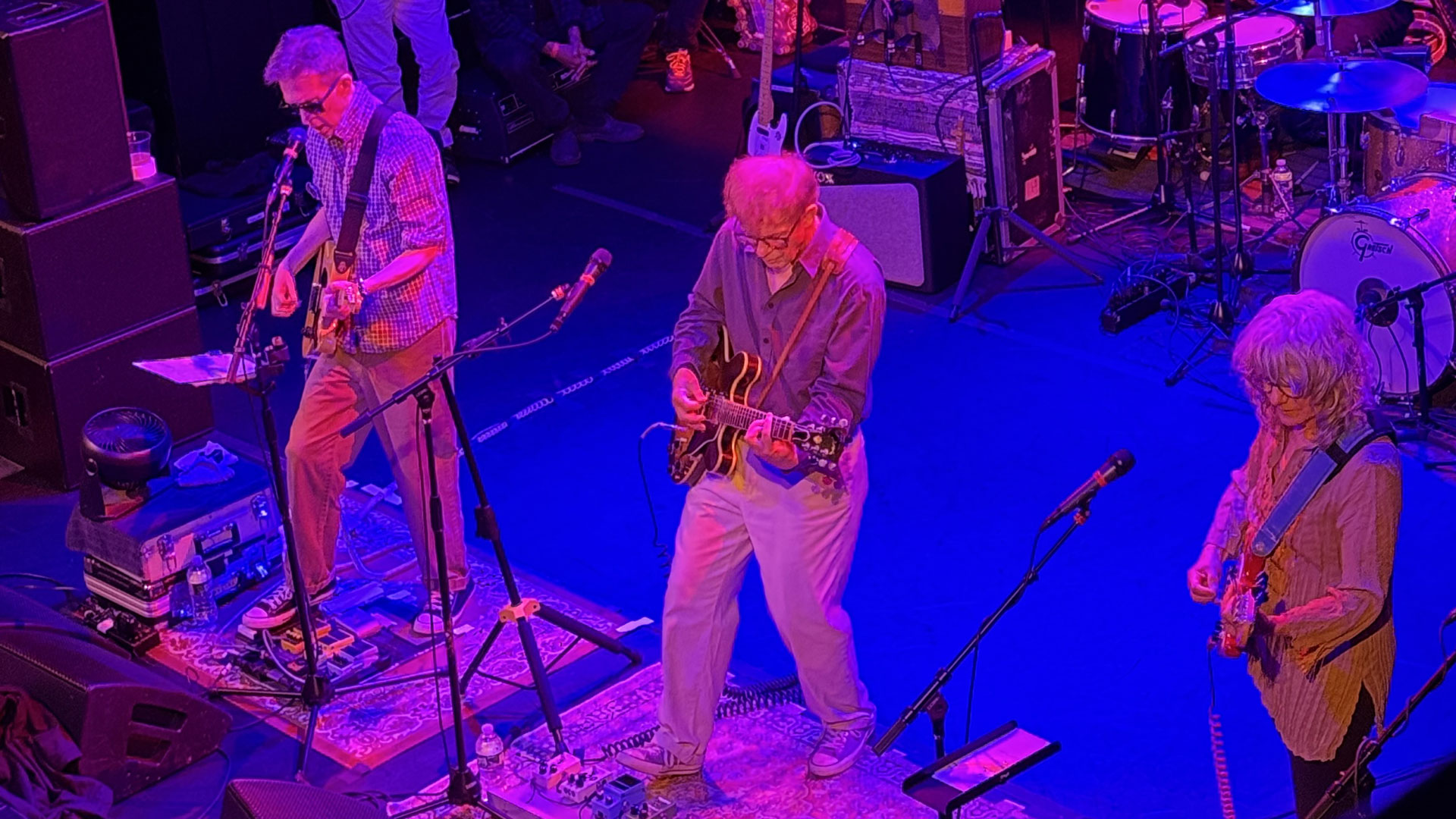
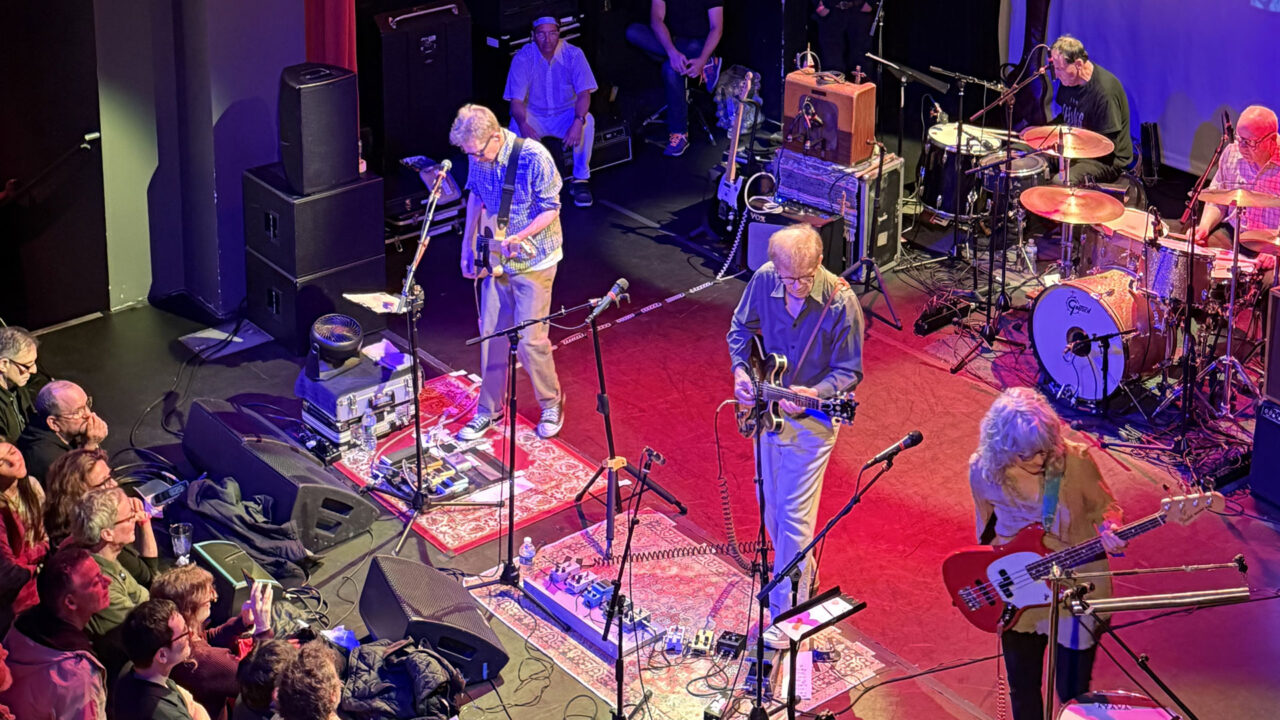
Last Saturday, I saw the Feelies play for roughly 3-and-a-half hours to an enraptured audience (me included) to celebrate 50 years of the band. The show was at White Eagle Hall in Jersey City — a favorite spot of the band to play now that Maxwell’s, the center of the Hoboken scene that spawned them, is no more. Rumors circulated that it would be their last show.
For a long time, I never thought I’d see the Feelies. I first read about them when I started to get into music, around 1988 or 1989. Spin was, at the time, an early Bible for discovering important bands to investigate. For example, I first read about No Wave in Spin, thanks to Byron Coley’s unmissable “Underground” column. I can’t recall who wrote about the Feelies, but I remember that bassist Brenda Sauter was quoted as recommending choline for touring bands to keep fatigue at bay. I’ve never toured but the advice has stayed with me ever since.
Soon after hearing about the Feelies in Spin, I rented Jonathan Demme’s new wave-y comedy, “Something Wild” (1986) — not just a great film but a whole encyclopedia of stuff to investigate more deeply. I mean, the soundtrack is impeccable, and the film is full of cameos — John Waters as a used car salesman (chef’s kiss); John Sayles as a hunky state trooper that Melanie Griffith’s mystery girl, Lulu, flirts with; Adele Lutz as a waitress; Su Tissue of Suburban Lawns as a pregnant Stepford mom-to-be (!!). And the biggest cameo of all? The Feelies as the Willies, the house band centerpiece of a plot-crucial high school reunion where Jeff Daniels, playing milquetoast-turned-closet-rebel Charlie Driggs, rides the high of falling for Lulu, then has the rug pulled out from him just as the Feelies launch into “Loveless Love” from their propulsive debut, “Crazy Rhythms.” Up until this point, the viewer has been lulled into thinking they’re watching a screwball comedy; now, on a dime, it turns into a noir thriller, thanks to the arrival of Lulu’s ex, a charming psychopath played with spine-chilling glee by Ray Liotta, in his first film role.
That the Feelies’ stalwart, sincere, resolutely untrendy music has persisted through thick and thin is a testament to their humble, steadfast belief in forging ahead.
Demme was one of the most musically attuned directors, and he adored the Feelies. For years, he wanted to make a Feelies documentary. While I can mourn what never happened, the Feelies’ extended cameo helped build a kind of slow-burning filmic fame for them. In a pre-YouTube wasteland (and remember, cable was not yet widely accessible), how great was it to watch what amounted to a mini-set from the band? More amazingly, they were allowed to be themselves, rather than a spit-shined movie version of the Feelies.
My nascent love for the band developed just as they were entering into a long period of dormancy in the early 1990s. They wouldn’t play together again until 2008, when Sonic Youth invited them to open for them on the Fourth of July. (The Feelies favor playing on national holidays.) I couldn’t contain my excitement. (Battery Park was so jammed full of people that I could only hear the Feelies, which was good enough for me.)
Since 2008, I’ve tried to see them whenever I can. They played Rhode Island a few times (including cramming themselves into the back of the much-missed Thayer Street record store and vintage emporium, What Cheer) and I also caught them in Cambridge. But I’ve seen them the most at White Eagle Hall, which is centrally located enough to be convenient for NYC music fans (a reverse bridge-and-tunnel schlep) and for myself to Amtrak up for the day.
It’s amazing to me that they’ve lasted fifty years — a milestone singularly lacking in the “Behind the Music”-style rancor, rehab and reunions that dogs most bands of a certain age.
That the Feelies’ stalwart, sincere, resolutely untrendy music has persisted through thick and thin is a testament to their humble, steadfast belief in forging ahead. Their determination to have fun on their own terms is reason enough to see their live show, which typically features multiple sets, numerous covers, guests galore and multiple encores. Here is a band that never sold out; you know they’re doing this because they love it.
You can trace the throughline of the Feelies’ formative influences through their choices of covers. On Saturday, we got a Velvet Underground cover or two (we got “What Goes On” with guest vocals by Richard Barone and a gorgeous “I’ll Be Your Mirror” with Georgia Hubley of Yo La Tengo on vocals). Stooges and the MC5? Why yes: “I Wanna Be Your Dog” and a raucous “Looking at You” with Ira Kaplan on vocals and guitar. Two songs by Wire (“Outdoor Miner” and “Mannequin”) and four by the Beatles (“Everybody’s Got Something to Hide Except for Me & My Monkey,” “It’s All Too Much,” Flying” and “She Said She Said”), but only one Rolling Stones song (“Paint It Black”). As an added treat, Dave Weckerman donned his vintage “Something Wild” tee and reprised his singing duties on “Fame,” turning it into a very Feelies-sounding nervy skiffle. (Missing from this roster: Eno’s “Third Uncle” and Kraftwerk’s “Kometenmelodie 2,” both of which have shown up on past setlists and reveal the Feelies’ interest in space, ambience and out-there abstraction, all of which put them slightly at odds with the more doctrinaire punk bands that they often played alongside during their early days of NYC gigging.)
I’ve barely even mentioned the band’s staggering catalog of original songs. The previous night’s show focused on “The Good Earth” (1986), played in full; tonight is devoted to “Crazy Rhythms” (very aptly titled), played in order and followed by later classics like “Nobody Knows,” “Away” and “Doin’ It Again.”
Trying to pin down the specialness of the Feelies’ unique sound is tough, but I feel like it comes down to the central conceit of pushing each instrument to its full percussive potential — both individually and collectively.
At this point, it’s beyond joyous to watch such a finely-honed band do their thing, so seemingly effortlessly. Hive-mind songwriters Glenn Mercer and Bill Million lock in with their complementary guitar lines (spiky vs. earthy) that skitter and weave around one another; bassist Brenda Sauter lays the foundation with the unhurried, unfussy strength of her playing. On the backline, Weckerman and Stan Demeski are the Odd Couple of percussion — Demeski has been rightfully called a “human metronome,” but his impeccable timekeeping is the opposite of soulless, while Weckerman’s collection of shakers, tambourines, mallets, bells and assorted noise-making objects is as fun to watch as it is somewhat unpredictable. And just as they did back at the Mudd Club in 1978, they can still stir their audience into a dancing frenzy.
If this is truly the last show, they certainly went out on their own terms. They survived fallow periods, fiscal uncertainty, major label disasters and everything in between. They can hold their heads high and know they never released a bad record or made decisions for anyone but themselves. (And we love them for it.)
My friend Harper joked when the Feelies played Brooklyn, Jersey City, Philadelphia, and Atlantic City back-to-back that they were playing their version of a world tour. It’s ironic that their touring circle was shrinking (from New England and NYC/Philly to just NY and NJ) just as their fan base was growing worldwide, thanks to reissues and word-of-mouth as an all-timer fan favorite.
If this is truly the end (and I hope I’m wrong — nothing has been definitively confirmed), it’s been a peerless run. I’ve been to a lot of shows in my life, but few have been as viscerally joyous as the Feelies shows I’ve been lucky enough to witness. And hey, “Something Wild” will always be there for me when I need it.
Adding this video of my favorite Feelies cover (tough call, I know): “Dancing Barefoot” from a White Eagle Hall show in 2022.